


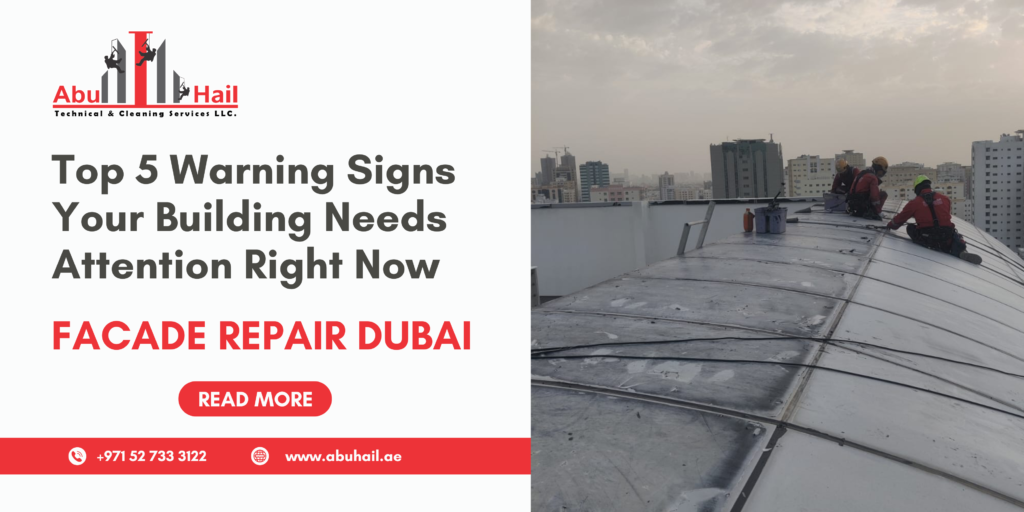
Facade repair Dubai is not a luxury — it is a safety and legal necessity. Every day, thousands of residents, employees, and pedestrians pass beneath the facades of Dubai’s iconic towers, residential complexes, and commercial buildings. Most assume those gleaming exteriors are structurally sound. But beneath the surface, unseen damage may be quietly growing — threatening the safety of everyone inside and outside the building.
Dubai’s climate is uniquely aggressive. With temperatures routinely exceeding 45°C in summer, intense UV radiation, coastal salt air in areas like Dubai Marina and JBR, and seasonal sandstorms, building facades in the UAE face some of the most punishing environmental conditions on earth. These forces act continuously on your building’s exterior — breaking down sealants, corroding metalwork, degrading concrete, and compromising the waterproof barriers that protect the building’s interior.
The challenge is that facade damage is often invisible until it becomes serious. By the time you notice a visible crack or a water stain on your interior ceiling, the underlying problem has usually been developing for months — sometimes years. The key to avoiding catastrophic failure, expensive repairs, and potential liability is recognising the early warning signs and acting before the damage escalates.
This guide, prepared by the experts at Abu Hail Technical & Cleaning Services LLC — Dubai’s trusted specialists in facade repair, maintenance, and restoration — covers the five most critical warning signs that your building needs professional facade repair in Dubai right now. Read carefully. One of these signs may already be present on your property.
Why Facade Health Matters More Than Ever in Dubai
Before diving into the warning signs, it is worth understanding why facade integrity is such a high-priority issue for Dubai property owners and facility managers in 2025 and beyond.
Building Safety Regulations in Dubai Are Getting Stricter
The Dubai Municipality and Trakhees enforcement bodies have progressively tightened requirements for building facade inspections and maintenance. Buildings found to have unsafe facades — particularly those shedding cladding, glass, or concrete — can face mandatory closures, fines, and legal action. Property owners and facility managers bear direct liability for injuries caused by falling facade elements. Keeping your facade in good repair is not only smart — it is legally required.
The Cost of Delay Is Exponential
A small sealant failure that costs a few hundred dirhams to fix today can evolve into a full waterproofing breakdown that costs tens of thousands to remediate. Spalling concrete that could be repaired with targeted patching can develop into structural reinforcement corrosion requiring major intervention. Every month of delay transforms a manageable maintenance task into a major capital project.
Property Value and Tenant Perception
In Dubai’s highly competitive real estate market, a building’s exterior condition directly influences its valuation, leasing appeal, and rental income. Visible facade deterioration drives tenants away, reduces occupancy rates, and depresses property values. Professional facade repair and maintenance is a direct investment in your asset’s financial performance.
Warning Sign #1: Visible Cracks in the Facade Surface
Facade repair Dubai professionals consider visible cracking to be the most universally misunderstood warning sign. Many building owners and managers dismiss fine surface cracks as cosmetic issues — a mistake that can prove extremely costly.
The Different Types of Cracks and What They Mean
Not all cracks are equal. Understanding the type of cracking helps determine the urgency of the required response.
Hairline Cracks (0.1mm – 0.3mm) These superfine cracks are often the first sign of thermal movement stress. Dubai’s extreme temperature cycling — buildings can experience a 25–30°C temperature differential between day and night — causes constant expansion and contraction of facade materials. Over time, this movement shears apart the microstructure of plaster, render, and concrete finishes, producing hairline networks. While individually small, these cracks provide pathways for water and moisture infiltration, which accelerates deterioration dramatically in a humid coastal environment.
Structural Cracks (>0.5mm, diagonal or horizontal) Cracks that run diagonally across facades, particularly those that follow a staircase pattern or appear at the corners of windows and door openings, are a serious structural warning. These patterns typically indicate differential settlement — the building’s foundation or structural frame is moving unevenly. In extreme cases, this type of cracking can indicate that load-bearing elements are under stress. This is an emergency requiring immediate professional assessment.
Spalling and Delamination When chunks of render, concrete, or cladding break away from the facade surface, the structural integrity of the facade system has been compromised. Spalling concrete is particularly dangerous because it often signals that embedded steel reinforcement has corroded and expanded, cracking the surrounding material from within — a condition known as concrete cancer.
What to Do
If you observe any cracking beyond fine surface checks — particularly diagonal structural cracks, cracks wider than 0.5mm, or any spalling — commission an immediate professional facade inspection. At Abu Hail Technical & Cleaning Services LLC, our rope access engineers can safely inspect even the highest and most inaccessible areas of your building’s exterior to assess the severity and extent of cracking, and recommend the appropriate facade repair solution in Dubai.
Warning Sign #2: Water Infiltration and Damp Patches Inside the Building
Water infiltration is the single most destructive force acting on any building facade. When your building’s waterproof envelope is breached — whether through cracked sealant joints, failed flashing, deteriorated render, or damaged cladding — water finds its way into the building fabric, causing damage that compounds over time.
How to Recognise Water Infiltration from Facade Failure
Water infiltration from facade failure often presents differently from plumbing or roof leaks, but the signs are unmistakable once you know what to look for:
Interior Damp Patches and Staining Brown or yellowish staining on interior walls and ceilings — particularly on perimeter walls or below window frames — is a classic indicator of water ingress through the facade. The staining pattern often reflects the pathway of the water through the wall construction.
Salt Efflorescence White, powdery deposits on exterior walls are caused by water carrying dissolved salts through the masonry and depositing them on the surface as it evaporates. Efflorescence is a reliable indicator that water is actively moving through your facade system. Left unaddressed, it causes progressive surface deterioration and — more seriously — signals that moisture is compromising the integrity of the wall construction behind the surface.
Mould and Mildew Growth The presence of mould or mildew on interior walls — especially on cold spots near window frames, balcony thresholds, or corners — indicates persistent moisture accumulation. Beyond the structural implications, mould poses a direct health risk to building occupants and creates significant legal exposure for property owners.
Rust Staining on Exterior Surfaces Orange-brown streaks running down a facade from metal fixings, window frames, or reinforcement bars indicate that moisture has penetrated to metallic components and is causing corrosion. The expanding corrosion products can accelerate concrete spalling and structural deterioration.
The Facade Sealant Problem
In Dubai’s high-rise buildings, the most common point of water entry is failed silicone sealant at facade joints. All facade systems — whether glass curtain wall, aluminium cladding, stone, or render — have joints that are sealed with silicone or other flexible sealants. These sealants have a finite service life. Exposure to Dubai’s UV radiation and thermal cycling degrades the sealant’s elasticity and adhesion, causing it to crack, harden, or pull away from the substrate. Once the sealant fails, water has a direct path into the building.
Abu Hail Technical & Cleaning Services LLC specialises in facade sealant rectification in Dubai — a highly skilled process that involves removing deteriorated sealant, preparing the substrate, and applying new high-performance sealant materials formulated for UAE climate conditions. This is one of the most cost-effective facade repair interventions available, provided it is carried out before water damage becomes extensive.
Warning Sign #3: Damaged, Loose, or Missing Cladding Panels
Modern Dubai buildings are frequently clad with aluminium composite panels (ACP), glass fibre reinforced concrete (GFRC), natural stone, ceramic tiles, or glass panels. These cladding systems provide weather protection, thermal insulation, and aesthetic finish. When cladding panels become damaged, loose, or displaced, they represent both a safety hazard and an indicator of deeper facade system problems.
The Safety Hazard of Loose Cladding
A dislodged cladding panel falling from height onto pedestrians, vehicles, or building occupants is a catastrophic outcome. Dubai has experienced several such incidents in recent years. The Dubai Municipality has strict requirements regarding cladding safety, and property owners who fail to maintain cladding in a secure condition face serious legal and financial consequences.
Loose cladding can often be identified from ground level by visual inspection — panels that appear displaced, bowed outward, or have visible gaps at their edges. However, many loose panels are not immediately visible from ground level and require a professional rope access inspection to identify safely.
Signs of Cladding System Failure
Bowing or Bulging Panels Panels that appear to bow outward from the wall plane indicate that the fixing system — typically a grid of aluminium rails and clips — has failed or that the substrate behind the panel has deteriorated. This is particularly common in older ACP installations where the original fixing specification has proved inadequate over time.
Displaced Expansion Joints Facade cladding systems are designed with expansion joints to accommodate thermal movement. When these joints become blocked with debris, fail to accommodate movement, or are installed incorrectly, panels can be pushed out of alignment as the material expands in summer heat.
Corroded or Failed Fixings The metal fixings that secure cladding panels to the building structure are typically made from stainless steel or galvanised steel. In coastal areas — particularly buildings within a few kilometres of the sea — salt air accelerates corrosion of these components. Corroded fixings may lose their structural capacity without any visible external indication.
Impact Damage Accidents involving building maintenance equipment, delivery vehicles, or adjacent construction activity frequently cause localised cladding damage. What appears to be minor denting or cracking may have damaged the fixing system behind the panel.
Facade Repair Dubai: Cladding Solutions
Abu Hail Technical & Cleaning Services LLC provides comprehensive cladding repair and replacement services for all types of building cladding in Dubai. Our rope access teams can safely access cladding at any height, carry out detailed condition assessments, replace individual damaged panels, re-secure loose fixings, and restore the sealant system around repaired panels — all without the need for costly scaffolding.
Warning Sign #4: Corroded Metal Elements and Concrete Cancer
Two of the most serious forms of facade deterioration — metal corrosion and concrete cancer — are often invisible in their early stages but devastating in their advanced form. Both are directly linked to moisture infiltration and both are alarmingly common in Dubai buildings, particularly those built in the 1990s and 2000s when construction quality control was less rigorous than today.
Understanding Concrete Cancer in Dubai Buildings
Concrete cancer — the colloquial term for alkali-silica reaction (ASR) or, more commonly in Dubai, chloride-induced reinforcement corrosion — is a process in which moisture and chloride ions from the environment penetrate the concrete cover and reach the steel reinforcement bars (rebar) inside. The rebar corrodes, and the rust products occupy a volume up to six times greater than the original steel. This expansion generates enormous internal pressure that literally cracks and explodes the concrete from within.
The visual signs of concrete cancer include:
- Brown or rust-coloured staining on the concrete surface
- Cracks running parallel to the direction of embedded reinforcement
- Spalling or delamination of the concrete surface
- Visible exposed rebar
In Dubai’s coastal environment, concrete cancer is accelerated by the high chloride content of the marine air and in some cases by the use of contaminated water in original construction. It is particularly prevalent in older buildings and in structures close to the sea.
This is not a cosmetic issue. Concrete cancer represents structural deterioration. If left unaddressed, it can compromise the load-bearing capacity of structural elements and create serious safety hazards.
Abu Hail Technical & Cleaning Services LLC’s concrete repair specialists are experienced in the diagnosis and remediation of concrete cancer — from removing deteriorated concrete and treating corroded rebar to applying corrosion inhibitors and restoring the concrete section with specialist repair mortars.
Metal Corrosion in Facade Systems
Aluminium frames, steel fixings, iron balustrades, window frames, and architectural metalwork are all common elements of Dubai building facades. While aluminium is naturally corrosion-resistant, steel and iron components are vulnerable to oxidative corrosion — particularly in marine environments.
Signs of metallic corrosion in your facade include:
- Orange-brown rust staining running down walls from metal elements
- Visible pitting, scaling, or loss of section on metal components
- Loose or failed fixings where corrosion has reduced their structural capacity
- Staining of glass or cladding panels below metal components
Rust removal, protective coating application, and where necessary, replacement of corroded metal elements are all within the facade repair capabilities of Abu Hail Technical & Cleaning Services LLC.
Warning Sign #5: Paint Fading, Peeling, and Surface Coating Failure
The outermost surface coating of your building — whether paint, texture coating, render, or protective sealant — is the first line of defence against Dubai’s harsh environment. Its role is not merely cosmetic. A properly functioning surface coating:
- Reflects UV radiation, reducing thermal loading on the building fabric
- Repels water, preventing moisture ingress
- Protects the underlying substrate from direct environmental exposure
- Seals micro-cracks and surface porosity
When this coating fails, the building’s entire protective system is compromised.
How Dubai’s Climate Attacks Surface Coatings
Dubai’s environmental conditions are uniquely hostile to surface coatings:
UV Degradation Dubai receives some of the highest levels of UV radiation of any major city in the world. UV radiation attacks the polymer bonds in paint and coating formulations, causing colour fading, chalking (a dusty, powdery surface deposit), and eventually loss of cohesion. A paint system designed for a temperate European climate may last 8–10 years in the UK but only 3–5 years in Dubai.
Thermal Cycling The repeated cycle of extreme daytime heat and cooler nighttime temperatures causes constant expansion and contraction of facade materials. Surface coatings must have sufficient flexibility to accommodate this movement. Rigid coatings that lose their elasticity over time will crack and peel.
Sandstorm Abrasion Dubai experiences frequent haboobs (sandstorms) that carry abrasive dust particles at high velocity. This physically erodes paint and coating surfaces, particularly on the windward faces of buildings.
Salt Spray For buildings near the coast or major highways (where road salt is used), salt deposition accelerates coating degradation and promotes osmotic blistering beneath paint films.
Recognising Surface Coating Failure
Chalking and Fading A chalky, powdery surface or significant colour fading indicates that the coating’s resin has broken down under UV attack. The coating is no longer providing effective protection.
Peeling and Flaking Paint or render that is peeling away from the substrate has lost adhesion. This is often caused by moisture infiltration beneath the coating (either from behind the wall or from surface water entry at cracks), or by application of the coating over an inadequately prepared or incompatible substrate.
Blistering Bubbles beneath the paint film indicate either moisture vapour pressure building up beneath the coating or contamination of the substrate at the time of application. Blistering invariably precedes peeling.
Cracking (Map Cracking / Crocodile Pattern) A network of fine cracks across the paint or render surface indicates that the coating has hardened and lost its flexibility. It is no longer accommodating the thermal movement of the underlying substrate. Water entry through these cracks will rapidly accelerate deterioration.
The Right Approach to Facade Repainting and Recoating
Effective facade recoating in Dubai is not simply a matter of applying a new layer of paint over the old one. Abu Hail Technical & Cleaning Services LLC’s facade coating specialists follow a rigorous process: complete removal of failed coatings, thorough surface preparation including cleaning, crack repair, and priming, followed by application of high-performance coating systems specifically formulated for UAE climate conditions — including elastomeric coatings that can bridge fine cracks and accommodate thermal movement.
The Consequences of Ignoring Facade Repair in Dubai
To understand the true cost of delay, consider what happens when each of these five warning signs is ignored:
A small sealant gap ignored for one season becomes a water infiltration pathway that saturates the wall construction, corrodes embedded metalwork, and triggers concrete cancer. The repair bill grows from a few thousand dirhams to hundreds of thousands. A single loose cladding panel that was not re-secured falls and injures a pedestrian — generating liability claims, regulatory investigations, and reputational damage that no maintenance budget can offset. Peeling render that was left unpainted for one more year falls away, exposing the structural substrate to direct weathering and requiring full render replacement rather than a simple repaint.
The mathematics of building maintenance are simple and unambiguous: preventive facade repair in Dubai costs a fraction of reactive restoration. Every warning sign you observe today is an opportunity to intervene at the lowest possible cost.
Why Choose Abu Hail Technical & Cleaning Services LLC for Facade Repair in Dubai?
Since 2011, Abu Hail Technical & Cleaning Services LLC has been one of Dubai’s most trusted and experienced providers of professional facade repair, maintenance, and restoration services. Here is what sets us apart:
IRATA-Certified Rope Access Teams All of our rope access technicians are IRATA (Industrial Rope Access Trade Association) certified — the international gold standard for working at height. Rope access eliminates the need for expensive scaffolding, dramatically reduces disruption to building operations, and allows our teams to access any area of your facade quickly and safely.
Comprehensive Facade Repair Capabilities From sealant joint rectification and crack repair to concrete cancer remediation, cladding replacement, glass fixing, waterproofing, and full facade repainting — Abu Hail Technical & Cleaning Services LLC provides a complete, end-to-end facade repair and maintenance service. You deal with one contractor, not five.
24/7 Emergency Response Facade emergencies — loose cladding panels, broken glass, sudden water ingress — require immediate action. Abu Hail Technical & Cleaning Services LLC operates a 24/7 emergency call-out service to respond to urgent facade safety situations.
Serving All of Dubai and the UAE We provide facade repair services across Dubai, Abu Dhabi, Sharjah, Ajman, Ras Al Khaimah, and throughout the UAE. No project is too large or too remote.
Transparent, Competitive Pricing We provide detailed written quotes for all facade repair work, and we guarantee to match or beat any comparable quote from a reputable competitor. Our surveys are always free of charge.
How to Get a Facade Inspection in Dubai
If you have noticed any of the five warning signs described in this article — or if your building has not had a professional facade inspection in the past 12 months — act now. A free, no-obligation facade survey from Abu Hail Technical & Cleaning Services LLC will give you a clear picture of your building’s exterior condition, identify any areas requiring facade repair in Dubai, and provide you with a detailed, prioritised maintenance plan.
📞 Contact Abu Hail Technical & Cleaning Services LLC
Ready to protect your building and ensure the safety of everyone inside?
Phone / WhatsApp: +971 52 733 3122
Email: info@abuhail.ae
Website: www.abuhail.ae
Address: Office 105, Oberai Building, Al Quoz 3, Dubai, UAE
Call or WhatsApp us today for your FREE facade inspection and no-obligation quote. Our team is standing by to help protect your building.
Frequently Asked Questions (FAQ) — Facade Repair Dubai
Q1: What is facade repair and why is it important for buildings in Dubai?
Facade repair refers to the process of identifying, diagnosing, and correcting defects in a building’s external envelope — including cracks, failed sealants, deteriorated coatings, loose or damaged cladding, and structural damage such as concrete cancer. In Dubai, facade repair is particularly important because the UAE’s extreme climate — intense UV radiation, high temperatures, coastal salt air, and sandstorms — accelerates the deterioration of facade materials at a rate significantly higher than in temperate climates. Proper facade repair protects the structural integrity of the building, prevents water infiltration, ensures the safety of occupants and pedestrians, and maintains the property’s value.
Q2: How often should a building in Dubai undergo a professional facade inspection?
Dubai Municipality guidelines and best practice standards recommend that buildings undergo a comprehensive professional facade inspection at least once every 12 months. Buildings in coastal locations (e.g., Dubai Marina, JBR, Palm Jumeirah) or those with a history of water ingress, cladding issues, or concrete deterioration should be inspected more frequently — typically every six months. High-rise buildings above 10 storeys should also conduct periodic rapid visual assessments from ground level between formal inspections.
Q3: What causes concrete cancer in Dubai buildings, and can it be repaired?
Concrete cancer in Dubai is primarily caused by chloride-induced corrosion of steel reinforcement. Chloride ions from coastal salt air and in some cases from poor quality construction water penetrate the concrete cover protecting the rebar. The rebar corrodes, expands, and causes the concrete to crack and spall. Yes, concrete cancer can be repaired — but only through a specialist process involving removal of all damaged concrete, treatment of corroded rebar with corrosion inhibitors, and reinstatement of the concrete section with compatible repair mortars. Abu Hail Technical & Cleaning Services LLC has specialist concrete repair teams experienced in the full diagnosis and remediation of concrete cancer in Dubai buildings.
Q4: What is facade sealant rectification and when is it needed?
Facade sealant rectification is the process of replacing deteriorated silicone or polyurethane sealants at the joints of facade systems. All facade types — glass curtain walls, aluminium cladding, stone, render — have joints sealed with flexible sealant materials. These materials have a service life of approximately 10–15 years under normal conditions, but Dubai’s intense UV radiation and thermal cycling can reduce this significantly. Signs that sealant rectification is needed include visible cracking, hardening, or shrinkage of the sealant bead, water infiltration at joint locations, and gaps or disbonding between the sealant and the facade substrate. Timely sealant rectification is one of the most cost-effective facade maintenance investments available.
Q5: How does rope access facade repair work, and is it safe?
Rope access is a method of working at height that uses industrial ropes, harnesses, descenders, and associated rigging equipment to position technicians at any point on a building’s exterior. Rather than erecting scaffolding or deploying costly aerial work platforms, rope access technicians are lowered or raised to the work location directly. It is extremely safe when performed by IRATA-certified technicians — the IRATA system mandates rigorous training, competency assessment, and safety standards. Rope access is faster, less disruptive, and significantly more cost-effective than scaffolding for facade inspection and repair work on Dubai’s high-rise buildings.
Q6: What types of facade cladding can Abu Hail repair?
Abu Hail Technical & Cleaning Services LLC has the expertise and equipment to repair, restore, and replace all types of building cladding commonly found on Dubai buildings, including aluminium composite panels (ACP), glass curtain wall systems, glass fibre reinforced concrete (GFRC) panels, natural stone and ceramic tile cladding, rendered and painted masonry facades, and architectural metalwork. Our teams can also address broken or cracked glass panels in curtain wall and window systems, aluminium frame damage, and all associated sealant and waterproofing systems.
Q7: How long does facade repair work take, and will it disrupt building operations?
Project duration depends on the scale and nature of the work required. A sealant rectification project on a 20-storey residential tower typically takes 2–4 weeks. A full facade repaint of a commercial tower may take 4–8 weeks. Because our teams use rope access rather than scaffolding, disruption to building operations, car parking, and pedestrian access is minimal. We work closely with building management teams to schedule work during hours that minimise inconvenience to tenants and visitors. Emergency repairs can be mobilised within hours of an initial assessment.
Q8: Does Abu Hail provide a warranty on facade repair work?
Yes. Abu Hail Technical & Cleaning Services LLC provides warranties on all facade repair works, with the warranty period varying depending on the type of work performed and the materials used. Warranty terms are clearly stated in all written quotations and contracts. We only use high-quality materials from reputable manufacturers that are specifically formulated for UAE climate conditions.
Q9: How do I get a quote for facade repair in Dubai?
Contact Abu Hail Technical & Cleaning Services LLC by phone, WhatsApp, or email to arrange a free, no-obligation facade survey. Our engineers will visit your property, conduct a thorough visual inspection (supplemented by rope access assessment if required for upper floors), and provide you with a detailed written report and competitively priced quotation within a few working days.
Phone / WhatsApp: +971 52 733 3122 Email: info@abuhail.ae Website: www.abuhail.ae
Q10: Is facade repair in Dubai covered by building insurance?
Facade repair may be covered by building insurance policies in cases where damage has been caused by a specific insured event — such as storm damage, fire, or impact by a vehicle or construction equipment. However, deterioration resulting from normal wear and tear, inadequate maintenance, or gradual environmental exposure is generally excluded from building insurance policies. We recommend checking your specific policy terms with your insurer. Regular maintenance and documented inspection records also support insurance claims in the event of a covered incident.
Final Thoughts: Don’t Wait Until It’s Too Late
Facade repair in Dubai is most effective — and most affordable — when it is proactive rather than reactive. The five warning signs described in this article — visible cracking, water infiltration, damaged or loose cladding, metal corrosion and concrete cancer, and surface coating failure — are the signals your building sends before a small problem becomes a large one.
If your building is displaying any of these signs, the time to act is now. Not next quarter. Not after the next budget cycle. Now.
Contact Abu Hail Technical & Cleaning Services LLC today for your free facade inspection. Protect your building, your tenants, and your investment.
📞 Call / WhatsApp: +971 52 733 3122
📧 Email: info@abuhail.ae
🌐 Website: www.abuhail.ae
📍 Office 105, Oberai Building, Al Quoz 3, Dubai, UAE