


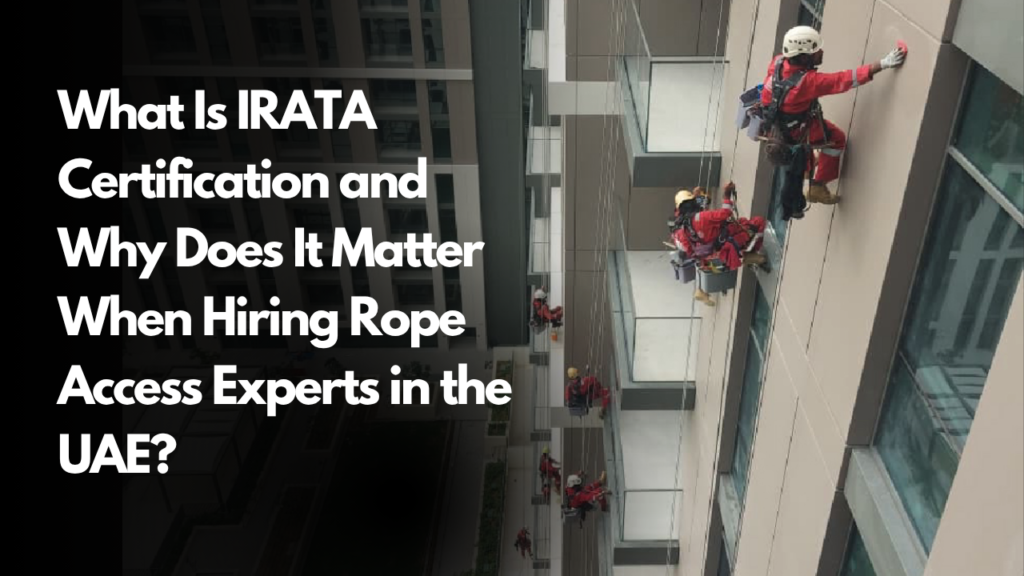
IRATA certified Dubai professionals are the gold standard when it comes to rope access, glass curtain wall installation, and high-rise facade maintenance across the UAE. If you own, manage, or develop a high-rise building in Dubai — whether it’s a commercial tower in Business Bay, a luxury residential complex in Dubai Marina, or an industrial facility in Jebel Ali — understanding IRATA certification is not optional. It is essential.
Dubai’s skyline is a global icon. From the record-breaking Burj Khalifa to the sprawling glass towers of DIFC and Downtown Dubai, buildings in this city are among the most architecturally complex in the world. Maintaining them — cleaning facades, replacing glass curtain walls, repairing sealants, installing lighting, or conducting structural inspections — requires working at tremendous heights under extreme conditions.
This is where IRATA certified rope access professionals come in. In this comprehensive guide, we will explain exactly what IRATA certification means, how the three levels work, why it matters for glass curtain wall installation in Dubai, and what questions you must ask before hiring any rope access company in the UAE.
What Is IRATA Certification? A Complete Overview
IRATA stands for Industrial Rope Access Trade Association. Founded in the United Kingdom in 1987, IRATA is the world’s leading authority for industrial rope access. It sets and enforces globally recognized safety and competency standards for technicians who work at height using rope access methods.
IRATA certification is not simply a training certificate. It is a formal, rigorously assessed qualification that verifies a technician’s ability to safely perform complex tasks at height — including glass curtain wall installation, facade inspections, structural maintenance, painting, silicone filling, and more.
IRATA operates under a philosophy sometimes called the “Three for Life” system: every rope access technician must have at minimum two independent ropes — a working rope and a safety rope — and both must be capable of bearing the full load independently. This redundancy is what makes IRATA-compliant rope access one of the safest working-at-height methods ever developed.
According to IRATA’s global safety statistics, the method has an industry-leading safety record with an incident rate per worker-hour that is significantly lower than scaffolding, cradle systems, or aerial work platforms. For a city like Dubai — where thousands of high-rise buildings require regular maintenance in extreme heat and wind conditions — this matters enormously.
Why Was IRATA Created?
Before IRATA established its framework, rope access work at height was largely unregulated. Technicians used inconsistent methods, substandard equipment, and had no standardized training. Fatalities and injuries were common. IRATA was founded by a coalition of UK oil and gas companies specifically to solve this problem.
Today, IRATA-certified rope access is used in over 55 countries. In the UAE and Dubai specifically, IRATA certification has become the benchmark that serious property owners, facility managers, and developers use when evaluating rope access contractors.
The Three Levels of IRATA Certification Explained
IRATA certified Dubai technicians are classified into three competency levels. Each level has specific requirements for logged work hours, technical skills, and assessed performance. Understanding the difference helps you hire the right team for your specific project.
IRATA Level 1 – Operative
Level 1 is the entry-level IRATA certification. To qualify, a technician must:
- Complete a formal IRATA training course with a Licensed Training Company (LTC)
- Pass a rigorous practical and theoretical assessment
- Accumulate at least 1,000 hours of documented rope access work to progress to Level 2
Level 1 technicians can perform basic rope access tasks under the supervision of Level 3 supervisors. In the context of glass curtain wall installation in Dubai, Level 1 operatives may assist with equipment rigging, rope setup, and straightforward cleaning or maintenance tasks.
IRATA Level 2 – Technician
Level 2 represents a significant step up in responsibility and skill. Level 2 IRATA certified Dubai technicians can:
- Work independently on more complex rope access tasks
- Perform rescue techniques on fellow technicians in emergency situations
- Supervise Level 1 operatives directly
- Manage intermediate rope access systems
For glass curtain wall installation and facade rectification in Dubai, Level 2 technicians are typically the primary workforce performing the physical work — installing glass panels, applying sealants, conducting facade inspections, and repairing cladding.
IRATA Level 3 – Supervisor
Level 3 is the highest IRATA certification level. Supervisors are responsible for:
- Full site safety management and risk assessment
- Developing and implementing method statements and rescue plans
- Supervising Level 1 and Level 2 technicians on complex projects
- Conducting final safety checks on all rope access systems
- Communicating directly with clients and project managers
When you hire an IRATA certified Dubai company like Abu Hail Technical & Cleaning Services LLC, every project is led by Level 3 supervisors who ensure total compliance with IRATA standards, UAE safety regulations, and Dubai Municipality requirements.
IRATA Level Summary |
Level 1 (Operative): Entry-level | Supervised work | Min. 1,000 hours logged before Level 2 |
Level 2 (Technician): Independent work | Rescue-capable | Can supervise Level 1 |
Level 3 (Supervisor): Full site management | Risk assessment | Method statements | Rescue plans |
Glass Curtain Wall Installation in Dubai: Why IRATA Certification Is Non-Negotiable
Glass curtain wall installation is one of the most technically demanding and high-risk services performed on Dubai’s high-rise buildings. A glass curtain wall is not just a surface finish — it is a load-bearing structural system that forms the building’s primary weather barrier, controls thermal performance, and contributes to fire safety compliance.
When glass panels in a curtain wall system need to be replaced, repaired, or newly installed at heights of 50, 100, or even 300+ meters above ground, the risks are extraordinary. Only IRATA certified Dubai technicians have the verified training, equipment knowledge, and risk management protocols to perform this work safely.
The Specific Risks of High-Rise Glass Work in Dubai
Dubai’s environment creates unique challenges for glass curtain wall installation that IRATA training specifically addresses:
- Extreme heat: Temperatures regularly exceed 45°C in summer, affecting equipment performance, worker fatigue, and glass panel behavior during installation
- High wind speeds: Dubai’s coastal location and urban heat island effect create unpredictable gusts at altitude
- UV radiation: Intense solar exposure accelerates degradation of ropes, harnesses, and sealants if not properly specified
- Dust and sand: Abrasive particles compromise rope integrity over time without proper inspection protocols
- Glazing weight: Individual glass panels for high-rise curtain walls can weigh hundreds of kilograms, requiring certified rigging and lifting competence
IRATA certified rope access technicians are trained specifically to assess and manage all of these risks. Non-certified workers using informal rope methods simply do not have the knowledge or legally documented competency to do so safely.
IRATA vs. Non-Certified Rope Access for Glass Curtain Wall Work
Factor | IRATA Certified Dubai | Non-Certified Rope Access |
Safety Standards | IRATA global standards + UAE regulations | No verifiable standard |
Technician Assessment | Formally assessed by independent IRATA examiner | Self-declared or informal |
Insurance Validity | Professional indemnity & liability valid | Often void or unenforceable |
Rescue Capability | Mandatory rescue training at all levels | Not required or verified |
Risk Assessment | Mandatory written method statements | Often absent or informal |
Legal Compliance | Compliant with Dubai Municipality & MOHRE | Potentially non-compliant |
Accident Liability | Clear accountability chain | Client may bear full liability |
Equipment Standards | IRATA-specified, regularly inspected | Unverified, potentially substandard |
Why IRATA Certification Matters Legally and Financially in the UAE
UAE Regulatory Compliance
The UAE has progressively strengthened its health and safety regulations for construction and facility maintenance. The Ministry of Human Resources and Emiratisation (MOHRE), Dubai Municipality, and Abu Dhabi Occupational Safety and Health Centre (OSHAD) all set requirements for working at height that align closely with international standards — including IRATA.
When you hire an IRATA certified Dubai contractor, you gain documented evidence that your maintenance activities comply with:
- Dubai Municipality Building Codes
- UAE Federal Law No. 8 of 1980 on occupational safety
- TRAKHEES regulations for Dubai free zones
- DEWA requirements for buildings with electrical facade components
- Relevant ISO and BS EN safety standards referenced by IRATA
Insurance and Liability Implications
This is the factor most property managers overlook until it is too late. If a non-IRATA certified worker is injured or killed on your building during rope access work, your insurance policy may be void. Most commercial property and public liability policies in the UAE contain clauses requiring that high-risk work at height be performed by properly qualified and certified contractors. Non-compliance means the insurer may refuse to pay claims — leaving property owners personally liable for damages, compensation, and legal costs that can reach millions of dirhams.
By contrast, engaging an IRATA certified Dubai rope access company like Abu Hail Technical Services LLC provides a legally defensible record of due diligence. Every project comes with documented method statements, risk assessments, and proof of technician certification — all of which are essential in any insurance claim or regulatory inquiry.
Project Delays and Penalties
Dubai’s regulatory environment is increasingly assertive about safety compliance. Projects using non-certified labour for high-risk access work risk stop-work notices, regulatory fines, and reputational damage. For commercial clients with tight handover schedules, the cost of a safety-related work stoppage can dwarf any savings made by hiring cheaper, non-certified contractors.
How Abu Hail Technical Services LLC Delivers IRATA-Certified Excellence in Dubai
Abu Hail Technical & Cleaning Services LLC has been delivering IRATA certified Dubai rope access solutions since 2011. Established by trained professionals with backgrounds in UK-standard industrial rope access, the company has grown to become one of the UAE’s most trusted and experienced rope access specialists.
With over 1,000 successful projects completed and more than 80 satisfied clients across the UAE — including landmark projects at Expo City Dubai, Wild Wadi Waterpark, Le Royal Meridien Beach Resort, and multiple Business Bay towers — Abu Hail brings proven competency to every assignment.
Our IRATA Certified Services in Dubai Include:
- Glass Curtain Wall Installation & Replacement — Complete rope access glass installation, from single panel replacement to full facade glazing systems on towers up to 200+ metres
- Facade Sealant & Silicone Application — Structural and weatherproofing sealant application with IRATA-certified teams at any height
- External Facade Cleaning — High-rise glass and cladding cleaning using IRATA-compliant rope access methods
- Facade Crack Repair & Rectification — Structural repair work on concrete, cladding, and glazing systems
- Facade Lighting Installation — LED and architectural lighting systems installed by rope access technicians
- Industrial & Offshore Rope Access — NDT inspections, painting, welding, confined space entry for oil & gas and marine clients
- High-Rise Painting Services — Exterior painting for commercial towers, residential buildings, and villas
- Solar Panel Cleaning — Specialist cleaning for rooftop and facade-mounted solar panels
- Signage Installation by Rope Access — Commercial signage placement on tower facades across Dubai
Our Certifications and Standards
Abu Hail Technical Services LLC maintains the following certifications and memberships, all of which verify our commitment to safety and quality:
- IRATA Membership — All rope access technicians hold current IRATA Level 1, 2, or 3 certification
- OPITO Stage 3 Rigging & Lifting — For offshore and marine operations
- DROPS Inspection Certified — Dropped Object Prevention Scheme for offshore sites
- Confined Space Entry Certified — For vessel, marine tank, and industrial confined space work
- 8+ Active Certifications — Covering all major service categories
Glass Curtain Wall Installation Process Using IRATA Certified Rope Access
Understanding the step-by-step process of glass curtain wall installation via rope access gives property owners confidence in the method. Here is how Abu Hail’s IRATA certified Dubai team approaches a typical glass panel replacement or new installation project:
Step 1: Pre-Project Site Survey & Risk Assessment
Before any rope is rigged, our IRATA Level 3 supervisor conducts a comprehensive site survey. This includes assessing anchor point locations and load ratings, identifying overhead hazards, reviewing existing facade drawings, measuring glass panel dimensions and weight, evaluating wind and weather conditions for scheduling, and preparing a full written Method Statement and Risk Assessment.
Step 2: Anchor Point Inspection & Certification
All structural anchor points used by rope access teams must be load-tested and certified. Our team verifies that roof-level anchors meet IRATA’s minimum requirements (typically 10kN per person in the working line and 15kN in the safety line). If existing anchors are non-compliant, we can install temporary certified anchor systems.
Step 3: Rope System Setup & Safety Check
IRATA certified Dubai technicians set up the rope access system using minimum two independent lines per person. Every piece of equipment — descenders, ascenders, karabiners, lanyards, harnesses, and rope protectors — is inspected before deployment. A pre-task briefing is conducted covering emergency rescue procedures.
Step 4: Glass Panel Preparation & Vacuum Lifter Rigging
For glass curtain wall installation, the correct handling of glass panels is critical. Our teams use IRATA-compliant rigging alongside specialist vacuum glass lifters. Panels are prepared on the ground, loaded into man-rated rigging systems, and carefully lifted to the installation level. Our vacuum glass lifter rental service provides the exact equipment needed for panels of any size.
Step 5: Glass Installation, Alignment & Sealant Application
At height, IRATA Level 2 technicians position and seat the glass panel precisely within the curtain wall frame. Structural glazing sealants or mechanical fixing systems are applied in accordance with manufacturer specifications. Our teams have extensive experience with spider glass systems, structural silicone glazing, and mechanical bolt-fixed glazing systems common in Dubai’s high-rise market.
Step 6: Quality Inspection & Sign-Off
After installation, the IRATA Level 3 supervisor conducts a comprehensive quality inspection of the completed work, checking alignment, sealant coverage, structural integrity, and water tightness. A project completion report is issued to the client with photographic documentation of all stages.
10 Questions to Ask Before Hiring an IRATA Certified Dubai Rope Access Company
Not all companies that claim to offer IRATA certified Dubai services are genuine. Here are the ten critical questions every property manager and facility director must ask before signing a contract:
- Can you provide copies of current IRATA membership certificates for all technicians assigned to my project? Genuine IRATA membership can be verified directly on the IRATA website by certificate number.
- What level of IRATA certification will be supervising this project? Always insist on an IRATA Level 3 supervisor on site for glass curtain wall installation and complex facade work.
- Do you hold professional indemnity and public liability insurance? What is the coverage limit? For high-rise glass work in Dubai, minimum coverage of AED 5–10 million is recommended.
- Can you provide a written Method Statement and Risk Assessment before work commences? This is a mandatory requirement under IRATA standards.
- What rescue plan is in place if a technician becomes incapacitated at height? IRATA standards require a documented rescue procedure.
- Are all ropes, harnesses, and equipment regularly inspected and certified? Ask for inspection records.
- How many projects of similar scope have you completed in Dubai? Request references and case studies.
- Are you compliant with Dubai Municipality and UAE MOHRE safety requirements? Ask for evidence of regulatory compliance.
- What is your safety record? Do you have any recorded IRATA incident reports? IRATA companies maintain safety records that are submitted annually.
- Do you carry specialist glass installation equipment, including certified vacuum lifters? Glass curtain wall installation requires specific tools that not all rope access companies possess.
IRATA Certified Dubai vs. Scaffolding: Which Is Better for Glass Curtain Wall Work?
A question frequently asked by Dubai property owners and project managers is whether to use rope access or traditional scaffolding for glass curtain wall installation and facade maintenance. For high-rise buildings in Dubai, the comparison is largely settled in favour of IRATA certified rope access for most applications.
Why Rope Access Outperforms Scaffolding in Dubai
- Speed of Mobilisation: IRATA rope access teams can be on-site and operational within hours. Scaffolding erection on a Dubai high-rise can take weeks and requires significant ground space.
- Cost Efficiency: Rope access eliminates the material, labour, and time costs of scaffolding. For high-rise glass curtain wall work, savings of 40–70% compared to traditional scaffolding are common.
- Minimal Disruption: IRATA certified Dubai teams can work on occupied buildings without restricting access to ground-level areas, car parks, or building entrances that scaffolding would block.
- Access to Difficult Areas: Rope access can reach areas of complex building geometry — recesses, overhangs, setbacks, and angled facades — that scaffolding simply cannot serve.
- Environmental Footprint: No scaffolding means no heavy material deliveries, no ground anchoring, and no disruption to surrounding properties or traffic — critical in densely built areas like DIFC and Downtown Dubai.
- Safety Record: IRATA’s global statistics consistently show that rope access has a lower serious incident rate per hour worked than scaffolding when performed by certified technicians.
Scaffolding remains the preferred method for certain project types — particularly where continuous access across large floor areas is required for extended periods, or where tasks require both hands free with no load-bearing requirement on the rope system. For glass curtain wall installation at height, however, IRATA certified rope access is almost always the superior solution in Dubai’s context.
The Future of IRATA Certified Rope Access in Dubai: 2026 and Beyond
Dubai’s construction and property maintenance sector continues to evolve rapidly. Several trends are shaping the future of IRATA certified Dubai services and glass curtain wall installation in the years ahead.
Green Building Standards and Facade Performance
As Dubai and the UAE pursue ambitious sustainability targets under the UAE Net Zero 2050 strategy and Dubai’s Clean Energy Strategy, high-performance glass facades are increasingly being specified for their thermal and solar control properties. This drives demand for precision glass curtain wall installation and ongoing maintenance by IRATA certified specialists who understand both the access and the performance requirements of these systems.
Drone-Assisted Rope Access Inspection
Forward-thinking IRATA certified companies in Dubai are beginning to integrate drone inspection technology with rope access operations. Drones provide initial facade condition assessments, allowing rope access teams to deploy directly to identified problem areas rather than conducting full manual surveys — improving efficiency and reducing cost for clients.
Tightening Regulatory Oversight
The UAE’s regulatory framework for working at height is becoming stricter. Dubai’s building management regulations and periodic facade inspection mandates are creating sustained demand for IRATA certified Dubai contractors who can provide both the access and the documented compliance evidence that regulators require.
Increased Demand from the Offshore Sector
The UAE’s offshore oil and gas sector — centred on Abu Dhabi but with support services operating across the UAE — continues to generate strong demand for IRATA and OPITO-certified rope access technicians for platform inspection, maintenance, painting, and NDT work. Companies like Abu Hail, which combine IRATA facade credentials with offshore rope access capability, are well positioned for this growing market.
Frequently Asked Questions: IRATA Certified Dubai & Glass Curtain Wall Installation
Q: What does IRATA certified Dubai mean?
A: It means that rope access technicians operating in Dubai hold a current certification issued by the Industrial Rope Access Trade Association (IRATA) — the world’s leading body for rope access safety standards. IRATA certified Dubai professionals have been formally assessed and verified as competent to perform rope access work at height to international safety standards.
Q: Is IRATA certification legally required for rope access work in Dubai?
A: While UAE law does not explicitly name IRATA certification as a mandatory requirement in all cases, it does require that high-risk work at height be performed by suitably qualified persons. IRATA certification is the internationally recognised benchmark for that qualification. Most major property owners, developers, and insurers in Dubai require IRATA certification as a contractual condition. Non-IRATA work can result in insurance voidance and regulatory liability.
Q: How many IRATA levels are there and which do I need for glass curtain wall installation?
A: There are three IRATA levels: Level 1 (Operative), Level 2 (Technician), and Level 3 (Supervisor). For glass curtain wall installation in Dubai, you need a team with at minimum Level 2 certified technicians performing the physical work and an IRATA Level 3 supervisor on site managing safety, risk assessment, and rescue planning.
Q: How do I verify that a company’s IRATA certification is genuine?
A: You can verify IRATA membership and individual technician certifications directly through the IRATA website (irata.org). Legitimate IRATA certified companies will provide you with individual technician certificate numbers that can be cross-referenced with IRATA’s records. Always request this verification before committing to any contract.
Q: What is the cost of glass curtain wall installation by IRATA certified rope access in Dubai?
A: Costs vary significantly based on panel size and type, building height, number of panels, project complexity, and access conditions. Rope access glass curtain wall installation is typically 40–70% more cost-effective than equivalent scaffolding-based approaches. Contact Abu Hail Technical Services for a detailed, no-obligation quotation tailored to your specific building and requirements.
Q: Can IRATA certified rope access be used for occupied buildings in Dubai?
A: Yes. One of the major advantages of IRATA certified rope access is the ability to work on fully occupied buildings with minimal disruption. Rope access teams work from the exterior, above, and do not require access to interior spaces or ground-level exclusion zones in most circumstances. This makes IRATA certified rope access ideal for hotels, residential towers, and commercial offices in continuous operation.
Q: How often should glass curtain walls in Dubai be inspected?
A: Dubai Municipality guidelines and best practice within the UAE property sector recommend facade inspections including glass curtain wall assessments at minimum every 5 years, with visual inspections annually. Given Dubai’s extreme climate — intense UV, heat, sandstorms, and coastal salinity — many building consultants recommend more frequent inspections every 2–3 years for high-value or complex facade systems.
Q: Does Abu Hail Technical Services offer emergency glass curtain wall repair in Dubai?
A: Yes. Abu Hail provides emergency glass repair and replacement services for high-rise buildings across Dubai and the UAE. Our IRATA certified Dubai teams can respond rapidly to storm damage, impact damage, and seal failures that pose immediate safety or weather-tightness risks. Contact us at +971 52 733 3122 for emergency enquiries.
Q: What equipment does Abu Hail use for glass curtain wall installation?
A: Our IRATA certified teams use IRATA-compliant rope access systems (working and safety lines, certified anchors, harnesses, descenders, ascenders), specialist vacuum glass lifting equipment rated for panel sizes commonly used in Dubai’s high-rise market, structural glazing tools, and weather monitoring equipment to ensure safe working conditions.
Q: Does Abu Hail serve locations outside Dubai?
A: Yes. Abu Hail Technical & Cleaning Services LLC provides IRATA certified rope access services across all UAE emirates including Abu Dhabi, Sharjah, Ajman, Ras Al Khaimah, Fujairah, and Umm Al Quwain. We also undertake offshore rope access projects in UAE territorial waters and have completed projects in other GCC countries.
Conclusion: Never Compromise on IRATA Certified Dubai Professionals
Whether you are planning a glass curtain wall installation, managing ongoing facade maintenance, or responding to an urgent repair on a Dubai high-rise, IRATA certified Dubai rope access professionals are not a premium — they are a necessity.
The consequences of hiring uncertified rope access labour are severe: safety incidents, insurance voidance, regulatory penalties, project delays, and the irreversible human cost of preventable accidents. In a city where buildings push the limits of height, design complexity, and environmental exposure, the expertise of IRATA certified technicians is what stands between successful projects and catastrophic failures.
Abu Hail Technical & Cleaning Services LLC has been Dubai and the UAE’s trusted IRATA certified rope access partner since 2011. With over 1,000 projects completed, 80+ satisfied clients, a 100% safety record, and teams of Level 1, 2, and 3 IRATA certified technicians ready to mobilise across the UAE, we deliver world-class glass curtain wall installation, facade maintenance, and high-rise technical solutions.
Contact Abu Hail today for a no-obligation consultation and site assessment. Our team will help you plan the safest, most efficient, and most cost-effective approach to your next high-rise project in Dubai or anywhere across the UAE.