


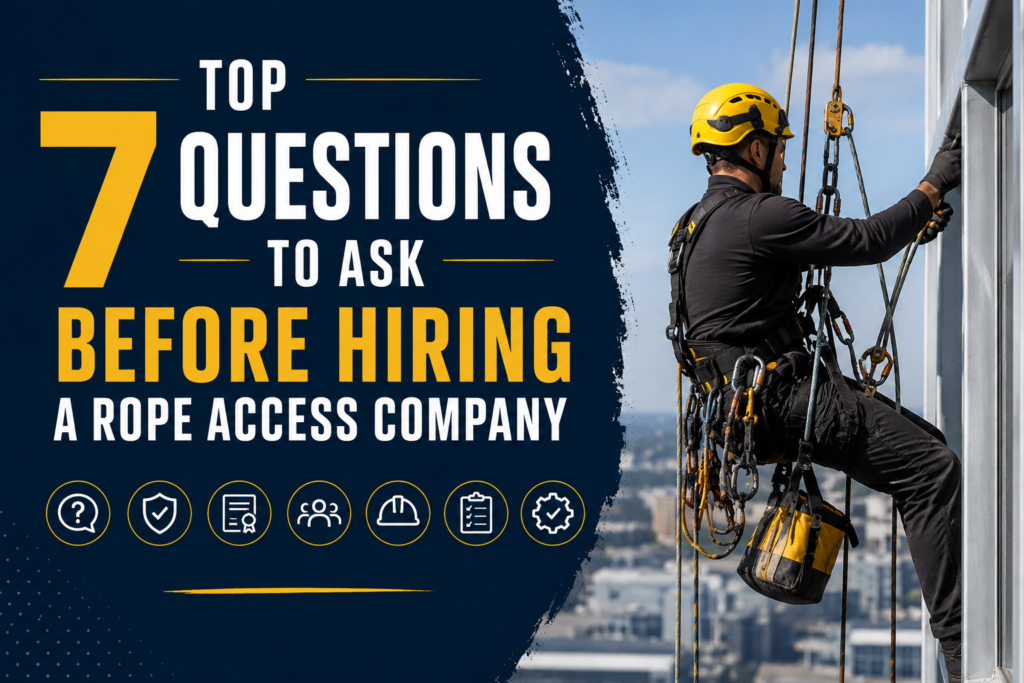
Top 7 Questions to Ask Before Hiring a Rope Access Company in UAE
Choosing the right rope access company in UAE is one of the most important decisions a building owner, facility manager, or developer will make this year. With Dubai and Abu Dhabi’s skylines packed with glass towers, villas, and industrial facilities that all need regular facade work, the difference between a safe, professional job and a costly, dangerous one almost always comes down to who you hire. Before you sign a single contract with any rope access company in UAE, you need clear answers to seven specific questions covering certification, insurance, safety systems, experience, equipment, and client references.
This guide walks through exactly what to ask, why each question matters, and what a genuine answer should sound like — so you can hire with confidence instead of guesswork. Whether you manage a residential tower in Dubai Marina, a commercial building in Business Bay, an industrial facility in Jebel Ali, or a villa community in Sharjah and Ajman, the underlying due-diligence process is the same. The companies that pass all seven checks tend to be the same ones already trusted with the UAE’s most visible buildings — and the ones that fail even one or two checks are usually the source of the horror stories property managers swap at industry events.
Quick Answer: Before hiring a rope access company in UAE, confirm they are IRATA certified, hold a valid UAE trade license, carry adequate insurance and liability cover, follow a documented safety management system, can show a verifiable project portfolio, use regularly inspected equipment, and have genuine client references you can actually call.
Table of Contents
- Why the Right Rope Access Company in UAE Matters
- Types of Rope Access Services You May Need
- Question 1: Is the Company IRATA Certified and Audited?
- Question 2: Do They Hold a Valid UAE Trade License?
- Question 3: What Insurance and Liability Coverage Do They Carry?
- Question 4: What Safety Management System Do They Follow?
- Question 5: How Much Experience and What Portfolio Can They Show?
- Question 6: What Equipment Do They Use and How Is It Maintained?
- Question 7: What Do Past Clients and References Say?
- How UAE’s Climate Affects Project Planning
- Red Flags That Mean You Should Walk Away
- How Abu Hail Answers Every One of These Questions
- What Influences the Cost of Rope Access Services in UAE
- How to Compare Quotes the Right Way
- Quick Checklist Before You Sign
- Frequently Asked Questions
Why the Right Rope Access Company in UAE Matters
Rope access work happens at height, often hundreds of metres above busy streets, on live facades, near oil tanks, or above offshore platforms. A poorly vetted rope access company in UAE doesn’t just risk a bad paint job or a missed deadline — it risks lives, damaged glass facades, voided insurance, and serious liability for the building owner who hired them. UAE municipalities and free zones are also tightening compliance requirements around working-at-height contractors, which means the paperwork you ask for today can protect you from fines and project shutdowns tomorrow.
On the other hand, the right rope access company in UAE brings trained IRATA technicians, proper rigging, documented risk assessments, and a track record you can verify — turning a high-risk activity into a routine, safely managed project. The seven questions below are the exact filter that separates the two.
| Question | Why It Matters | What a Good Answer Looks Like |
|---|---|---|
| 1. IRATA certified? | Proves technicians are trained to an internationally audited safety standard | Valid IRATA member company number + individual technician ID cards |
| 2. UAE trade license? | Confirms legal right to operate and be held accountable | Current DED / free zone license matching the company name on the quote |
| 3. Insurance & liability? | Protects your building, the public, and the workers | Third-party liability + workmen’s compensation certificates, with coverage amounts |
| 4. Safety system? | Shows accidents are prevented, not just reacted to | Written method statement & risk assessment (MSRA) per project |
| 5. Experience & portfolio? | Confirms they’ve done this exact type of work before | Named buildings, photos, and years in the UAE market |
| 6. Equipment & maintenance? | Faulty gear is the leading cause of rope access incidents | Equipment inspection logs and replacement schedule |
| 7. Client references? | The only proof that isn’t self-reported | Phone numbers or emails of real clients you can contact directly |
Types of Rope Access Services You May Need in the UAE
Before you start comparing companies, it helps to be clear on exactly what kind of rope access work your building requires, since not every rope access company in UAE covers every type of project. The most commonly requested services include:
- Facade rope access services — general high-rise cleaning, inspection, and access for maintenance crews
- Facade glass replacement and glass fixing — removing and installing cracked, scratched, or outdated glazing panels
- Facade sealant and silicone replacement — preventing water ingress and structural damage around joints and panels
- Offshore rope access services — inspection, NDT, rigging, and maintenance on oil and gas platforms
- Vessel and marine tank cleaning — confined space entry and cleaning for ships and storage tanks
- Industrial rope access — crack testing, non-destructive testing, and inspection work in industrial facilities
- High-rise and villa painting — exterior painting carried out safely at height without scaffolding
- Solar panel cleaning — maintaining panel efficiency on rooftops and facades
- Facade lighting installation and repair — replacing or upgrading building lighting systems at height
A rope access company in UAE that can demonstrate genuine, hands-on experience across several of these categories — rather than claiming to “do everything” with no specifics — is generally a stronger long-term partner, since they can scale with your building’s needs over time instead of requiring you to manage several different contractors.
Question 1: Is the Rope Access Company IRATA Certified and Audited?
This is the single most important question to ask any rope access company in UAE. IRATA — the Industrial Rope Access Trade Association — is the internationally recognised body that sets training, supervision, and safety standards for rope access work. An IRATA-certified company has technicians who hold individual certification (Level 1, 2, or 3) that must be renewed every three years, and the company itself is regularly audited against IRATA’s code of practice.
Ask the company for their IRATA member number, and ask to see individual technician ID cards before work begins, not after. A genuine company will produce these without hesitation because the information is part of the public IRATA register.
Why This Matters for a Rope Access Company in UAE Specifically
The UAE has no single unified working-at-height licensing body the way some countries do, which means IRATA certification is often the strongest independent proof of competence available to a building owner here. Without it, you are relying entirely on the company’s own word.
Red flag: The company says they are “rope access trained” but cannot provide an IRATA number or individual technician certificates on request.
What good looks like: A documented IRATA member number, certificates for every technician assigned to your job, and a supervisor on site holding at least IRATA Level 3.
Question 2: Do They Hold a Valid UAE Trade License and Local Registration?
A legitimate rope access company in UAE must hold an active trade license from the relevant Department of Economic Development (DED) or free zone authority that explicitly covers building maintenance, facade cleaning, or technical access services. This matters for two practical reasons: it confirms the business is legally accountable, and it ensures any contract you sign is enforceable.
Ask to see the trade license and check that the company name on the license matches the name on your quotation and invoice. Mismatched names are one of the most common ways unlicensed subcontractors slip into a project undetected.
What to Cross-Check on the License
- License expiry date — is it currently active?
- Business activity description — does it cover rope access / facade / cleaning services?
- Registered emirate — does it match where the work will be carried out, or do they hold the correct mainland/free zone permissions?
Question 3: What Insurance and Liability Coverage Do They Carry?
Insurance is where many property owners get caught out. A rope access company in UAE working on your building should carry, at minimum: third-party public liability insurance, workmen’s compensation (covering injury to their own staff), and ideally professional indemnity if the scope includes inspection or certification work.
Ask for the actual insurance certificate, not just a verbal assurance, and check the coverage amount against the scale of your project. A high-rise facade job carries very different risk exposure than a single-storey villa repaint, and the policy limits should reflect that.
Red flag: “We’re covered under our general business insurance” with no specific document offered for review.
What good looks like: A named insurance certificate with policy number, coverage amount, and validity dates, emailed to you before the contract is signed.
Question 4: What Safety Management System and Risk Assessments Do They Follow?
Certification covers the people; a safety management system covers the process. Every reputable rope access company in UAE should produce a written Method Statement and Risk Assessment (MSRA) specific to your building before work starts — not a generic template reused across every job. This document should identify hazards specific to your site (pedestrian areas below, glazing type, anchor points, wind exposure, nearby power lines) and outline exactly how each will be controlled.
Daily Safety Practices to Ask About
- Pre-job equipment inspection and sign-off sheets
- Weather monitoring policy (wind speed limits for working at height)
- Emergency rescue plan and trained rescue technician on site
- Permit-to-work system for confined spaces or live facades
- Toolbox talks before each shift
A company that cannot describe its risk assessment process in specific terms — or simply says “we’re always careful” — has not earned the trust required to work above your building or your staff.
Question 5: How Much Experience and What Portfolio Can They Show?
Years in business matter, but relevant experience matters more. Ask the rope access company in UAE to show projects similar in scale and type to yours — whether that’s facade glass replacement on a high-rise tower, offshore platform maintenance, marine tank cleaning, or villa exterior painting. A company that has spent over a decade working on UAE towers will understand local challenges that a newcomer simply hasn’t encountered yet: extreme summer heat affecting sealants, sandstorm dust on glazing, and the logistics of working above occupied residential units.
What to Ask to See
- Named building examples (not just stock photography)
- Before-and-after photos from their own completed projects
- Number of similar projects completed in the past 12 months
- Whether they have worked in your specific emirate or free zone before
Question 6: What Equipment Do They Use and How Is It Inspected and Maintained?
Rope access depends entirely on the integrity of ropes, harnesses, descenders, anchors, and carabiners. Equipment failure — not technique failure — is behind a large share of preventable rope access incidents worldwide. Ask the company how often equipment is inspected, who carries out the inspection, and how worn or expired gear is retired from use.
| Equipment Question | Why It Matters |
|---|---|
| How old is the rope and harness inventory? | Rope and webbing degrade with UV exposure and use, even with no visible damage |
| Is there a logged inspection record per item? | Proves a system exists rather than relying on memory |
| What backup/redundancy systems are used? | Two independent rope systems are standard best practice, not optional |
| Who supplies the equipment — owned or rented? | Owned, well-maintained kit is generally a stronger sign of commitment to safety |
Question 7: What Do Past Clients and References Say?
Marketing materials and a polished website can only tell you so much. The most reliable check on any rope access company in UAE is to speak directly with two or three of their past clients — ideally for projects similar to yours. Ask the company for contact details of recent clients, and follow up with simple, direct questions: Did the team arrive on schedule? Was the site left clean? Were there any safety incidents? Would you hire them again?
Genuine online reviews on Google Business and verified project case studies on the company’s own website are useful supporting evidence, but a real phone conversation with a previous client remains the single most honest source of information you can get before signing a contract.
Red flag: The company is reluctant to share any client contact details, or only offers written testimonials with no way to verify them.
What good looks like: A company that proactively offers references, case studies with named buildings, and a visible portfolio of completed UAE projects.
How UAE’s Climate Affects Rope Access Project Planning
An experienced rope access company in UAE will also factor the region’s climate into how a project is planned, not just how it is executed. Extreme summer heat, intense UV exposure, high humidity near the coast, and occasional sandstorms all affect both the safety of working at height and the longevity of the work being carried out.
- Heat and wind limits: Most professional rope access teams pause outdoor work during the hottest midday hours in summer and have clear wind-speed cut-offs for safety, which a good company will explain upfront rather than letting it become a surprise delay later.
- Sealant and paint curing: Facade sealant, silicone, and paint all cure differently depending on temperature and humidity, which affects scheduling and the choice of materials used on your building.
- Dust and sand exposure: Glass facades and freshly painted surfaces are more vulnerable to dust accumulation during sandstorm season, which can influence the best time of year to schedule cleaning or painting work.
- Coastal salinity: Buildings near the coast in Dubai, Sharjah, or Ajman face faster corrosion of metal fixtures and sealant breakdown, which an experienced local rope access company in UAE will already account for in their maintenance recommendations.
Ask any shortlisted company how they adjust scheduling and materials for UAE conditions specifically. A vague answer here is often a sign the company hasn’t worked in the region long enough to have learned these lessons firsthand.
Red Flags That Mean You Should Walk Away
Beyond the seven questions above, a few warning signs tend to repeat across problem contractors in the rope access and facade maintenance space in the UAE:
- Unusually low quotes far below every other company you’ve approached, with no clear explanation
- Pressure to sign immediately, with no time to review documents
- No written method statement or risk assessment offered for the specific job
- Subcontracting the work to an unnamed third party without disclosure
- No physical office or verifiable UAE business address
- Reluctance to put insurance, license, or IRATA details in writing
Any one of these alone may have an explanation. Two or more together are a strong signal to keep looking.
How Abu Hail Answers Every One of These Questions
Abu Hail Technical & Cleaning Services L.L.C. was established in 2011 and has grown into one of the most experienced rope access companies in the UAE, with over 1,000 completed projects and a long-standing safety record across facade, marine, and industrial access work. Here’s how Abu Hail addresses each of the seven questions covered in this guide:
- IRATA Certified: Abu Hail operates with an IRATA-trained and certified rope access squad, with technicians holding valid individual certification.
- Licensed & Registered: Abu Hail Technical & Cleaning Services L.L.C. is a properly licensed UAE company with a verifiable trade registration.
- Insured Operations: Projects are carried out under the company’s documented liability and safety framework, with coverage discussed transparently at the quotation stage.
- Documented Safety Process: Every project includes site-specific risk assessment and method statements before any technician goes on rope.
- Proven Experience: Abu Hail’s portfolio spans facade rope access, offshore platform services, vessel and marine tank cleaning, industrial access, glass replacement, glass fixing, facade lighting, solar panel cleaning, and villa and high-rise painting across Dubai and the wider UAE.
- Maintained Equipment: Spider lifts, vacuum glass lifters, scissor lifts, and rope access kit are maintained to support both rope access and equipment rental projects.
- Verifiable Track Record: With 100+ satisfied clients and a downloadable company profile, Abu Hail’s history is available for review before you commit.
If you’d like to see how Abu Hail compares against the checklist in this article, request a company profile and project portfolio directly through the contact details at the end of this guide.
What Influences the Cost of Rope Access Services in UAE
Once you’ve shortlisted a rope access company in UAE that passes all seven questions, cost becomes the next practical conversation. Pricing for rope access work in the UAE typically depends on:
- Building height and access complexity — taller towers and complex facade geometry require more rigging time and technicians
- Scope of work — a single glass replacement is priced very differently from a full facade cleaning or painting contract
- Equipment required — rope access alone versus combined use of spider lifts or scissor lifts for parts of the job
- Project duration and team size — number of certified technicians needed to complete the work within the agreed timeframe
- Site conditions — occupied buildings, restricted working hours, or coastal/offshore locations can add logistical cost
Always request an itemised quote rather than a single lump figure, so you can see exactly what is included — labour, equipment, materials, insurance, and any standby or emergency callout terms. Be especially cautious of quotes that bundle everything into one number with no breakdown; this is often where hidden costs or under-scoped work appear later as “variations” once the project has already started.
How to Compare Quotes the Right Way
Once you have shortlisted two or three companies that pass the seven-question test, comparing their quotes fairly takes a little more than looking at the bottom-line number. Make sure each quote covers the same scope of work, the same number of access days, and the same equipment before comparing prices side by side — otherwise you may be comparing a basic cleaning quote against a full facade rectification package without realising it.
- Confirm whether mobilisation, equipment rental, and waste disposal are included or charged separately
- Check the payment schedule — a reasonable deposit followed by milestone payments is standard; a full upfront payment request is not
- Ask whether the quote includes a warranty period for workmanship, particularly for sealant, painting, or glass installation work
- Clarify what happens if weather delays push the project beyond the planned schedule
A transparent rope access company in UAE will welcome these questions, since clear scope and payment terms protect both sides of the contract equally.
Quick Checklist Before You Sign
- ✅ IRATA member number and individual technician certificates verified
- ✅ Valid UAE trade license matching the company name on the quote
- ✅ Insurance certificate reviewed with adequate coverage for your project scale
- ✅ Site-specific method statement and risk assessment provided in writing
- ✅ Relevant project portfolio shown, with named buildings and photos
- ✅ Equipment inspection and maintenance process explained clearly
- ✅ At least one past client reference contacted directly
- ✅ Itemised quotation received, with no pressure to sign on the spot
Frequently Asked Questions
What is the most important question to ask a rope access company in UAE?
IRATA certification is the most important single question, because it is independently audited and applies to both the company and each individual technician, rather than relying on the company’s own claims.
Is rope access safer than scaffolding for high-rise work in the UAE?
When carried out by an IRATA-certified company with proper risk assessments, rope access is widely regarded as a safe and efficient alternative to scaffolding, with faster setup, less disruption to building occupants, and a strong global safety record.
How do I verify a rope access company’s IRATA certification?
Ask for the company’s IRATA member number and request to see individual technician certification cards before work begins. You can also check directly with IRATA’s official member directory.
What insurance should a rope access company in UAE carry?
At minimum, third-party public liability insurance and workmen’s compensation cover for their own staff. Larger or higher-rise projects should also have coverage limits matched to the scale and risk of the work.
How much does hiring a rope access company in UAE typically cost?
Costs vary based on building height, scope of work, equipment needed, and project duration. It’s best to request an itemised quote from each shortlisted company so you can compare like for like.
Can a rope access company in UAE also handle glass replacement and painting?
Yes — many established rope access companies, including Abu Hail, offer combined services such as facade glass replacement, glass fixing, painting, and facade lighting using the same rope access technicians and equipment.
What documents should I request before signing a contract?
A valid trade license, IRATA certification details, an insurance certificate, a site-specific method statement and risk assessment, and an itemised quotation.
How quickly can a rope access company in UAE start a project?
This depends on the scope of work and the company’s current schedule, but most established providers can carry out a site survey and provide a start date within a few working days of initial contact.
Looking for a Trusted Rope Access Company in UAE?
Abu Hail Technical & Cleaning Services L.L.C. has delivered IRATA-certified rope access, facade, glass, and high-rise maintenance solutions across the UAE since 2011 — with 1,000+ completed projects and a strong safety record. Get a free, no-obligation site assessment and quote today.
Email: info@abuhail.ae | Hours: Mon–Sat, 8:30 AM–6:00 PM (Sunday Closed) | Visit Contact Page